
Workplace Heretic
A Workplace Heretic is someone who refuses to call dysfunction normal.
They notice when the official story does not match what is actually happening. They ask questions other people have learned not to ask. They care about the work, which is often why they have such a hard time staying quiet when something is wrong.
Some are outspoken. Others are quietly holding a line no one else can see. Many have been called difficult, negative, intimidating, insubordinate, or “not a team player” when the real problem was that they would not pretend.
I call them heretics because every dysfunctional workplace has an orthodoxy: a collection of stories everyone is expected to accept, even when experience says they are not true.
Being a Heretic Is Not About Being Difficult
Not every bad day means the workplace is broken. Not every disagreement is mistreatment. And being right does not automatically make every response wise. A Workplace Heretic learns to separate what is known from what is suspected, recognize patterns without exaggerating them, and examine their own behavior with the same honesty they expect from everyone else. The goal is not to win every argument or expose every hypocrite. It is to see the situation clearly enough to decide what deserves a response, what requires protection, and what is no longer worth the cost.
01
Honest
Tell yourself the truth about what is happening. That includes the truth about the workplace, the people involved, the choices available to you, and your own part in the situation. Honesty means neither minimizing the problem nor making it larger than it is.
Boundaried
02
Decide what the situation is allowed to take from you. A boundary is not a demand that someone else change. It is a decision about what you will participate in, what you will protect, and what you will do when a line is crossed.
03
Intentional
Choose your actions instead of letting the latest crisis choose them for you. Leaving may be the right decision. Staying may be the right decision. Speaking up, documenting, waiting, stepping back, or changing direction may also be right. What matters is understanding the likely cost of each choice and making it deliberately.
The Book!
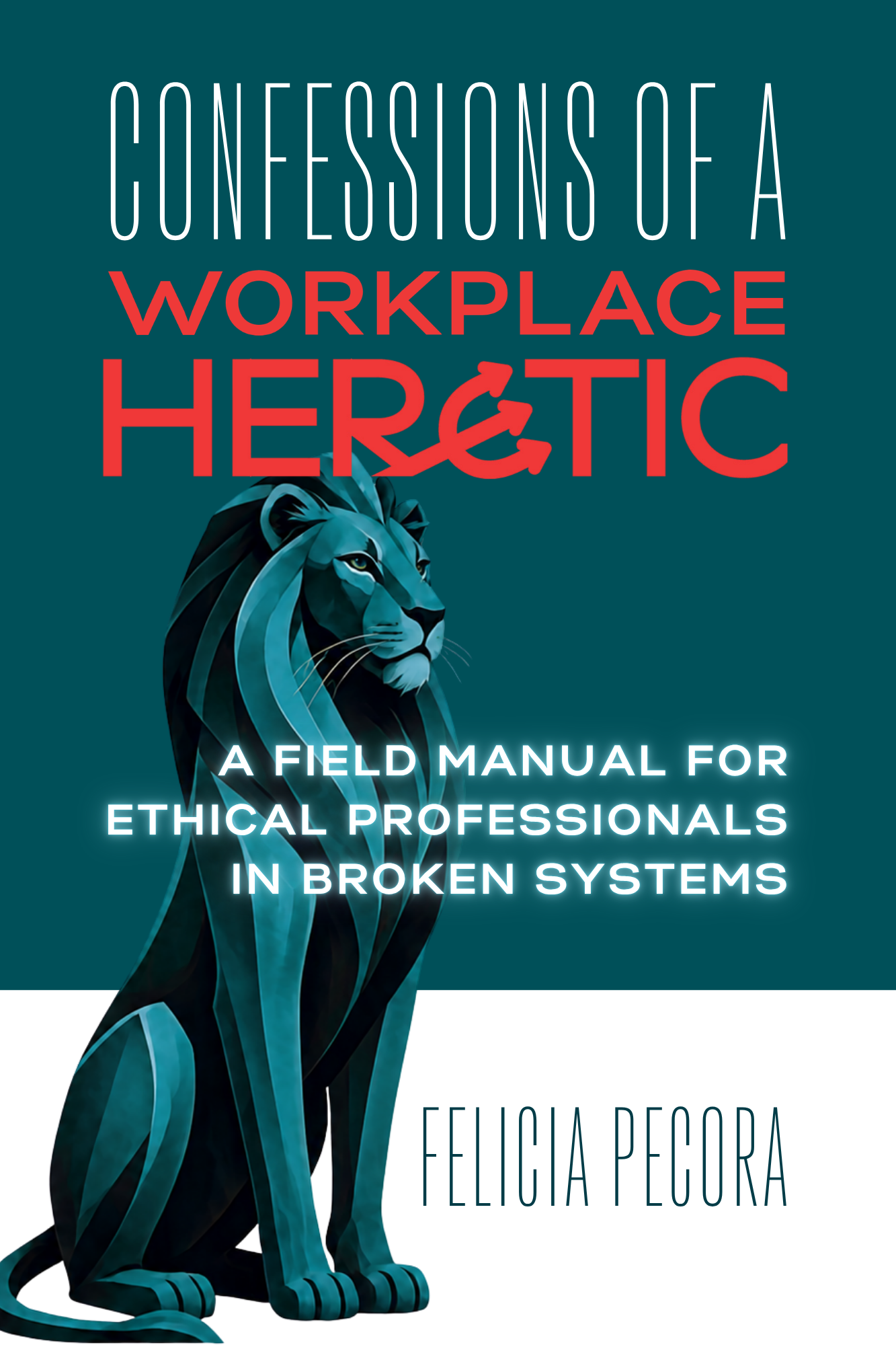
Confessions of a Workplace Heretic
Confessions of a Workplace Heretic: A Field Manual for Ethical Professionals in Broken Systems grew out of my own experiences inside workplaces where the official version of events bore little resemblance to reality.
The Workplace Heretic Card Deck
Sometimes you do not need another chapter. You need one clear thought in front of you.
The Workplace Heretic Card Deck contains 56 cards organized around seven essential skills: Awareness, Ownership, Clarity, Boundaries, Agency, Resilience, and Auctoritas.
You May Be a Workplace Heretic If...

You have been called difficult for asking a reasonable question.
You have watched the person who identified a problem be referred to as "the problem."
You have been expected to protect an organization that would not protect its people.
You care about the work but no longer trust the system surrounding it.
You are trying to decide whether to speak, stay, leave, fight, wait, or let go.
You are not looking for permission to be reckless. You are trying to make a decision you can live with.
If any of this feels familiar, you are not the only one.
Free Workplace Heretic Resources
Worksheets
Sometimes you need help sorting out what is happening before you can decide what to do about it.
These free downloads can help you recognize patterns, document what matters, think through your choices, set clearer boundaries, and protect yourself while you decide what comes next.
Free field guides
Use these worksheets to recognize patterns, document what matters, define a boundary, and decide what comes next.
Tell Me Your Workplace Heretic Moment
Have you ever said what everyone else seemed to be thinking? Been labeled difficult for refusing to ignore something important? Realized much later that you were never the problem they said you were?
I would like to hear about it.
Please leave out names or details that could identify your employer or the people involved. Your story will remain private unless you separately give me permission to share it.